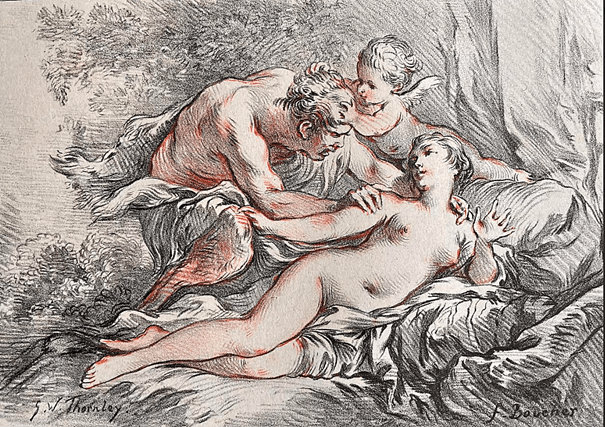
Antiope et le Satyre (aux deux crayons). Lithographie de William Thornley. Dimensions : Visuel de la lithographie de William Thornley, H.12,5cm x L. 18cm ; planche avec visuel : H.31cm x H.44cm. Les signatures de François Boucher (1703-1770) et Georges William Thornley (1857-1935) sont inversées par rapport à l’ordre conventionnel. Collection privée.
Il s’agit de la dix-septième lithographie du second recueil réalisé par William Thornley d’après François Boucher, recueil publié en 1881. Traitée « aux deux crayons » (à la façon de), elle représente Antiope et le Satyre. Selon le récit mythologique fait par le poète grec Homère, Antiope est la fille du dieu Asopos. Ovide ( 43 av J.C – 17 ap J.C), dans son écrit sur Les métamorphoses rapporte que Zeus séduisit la très belle Antiope en prenant les traits d’un Satyre.

Antiope and the Satyr (two crayons). Lithograph by William Thornley (private collection). Dimensions: Image of the lithograph by William Thornley, H. 12.5 cm x W. 18 cm; plate with image: H. 31 cm x H. 44 cm. The signatures of François Boucher and G.W. Thornley are reversed from the conventional order.
This is the seventeenth lithograph in the second collection produced by William Thornley from a model of François Boucher, published in 1881. Executed in the style of Boucher, it depicts Antiope and the Satyr. According to the mythological account by the Greek poet Homer, Antiope is the daughter of the god Asopus. Ovid (43 BC – 17 AD), in his Metamorphoses, recounts that Zeus seduced the beautiful Antiope by taking the form of a Satyr.